
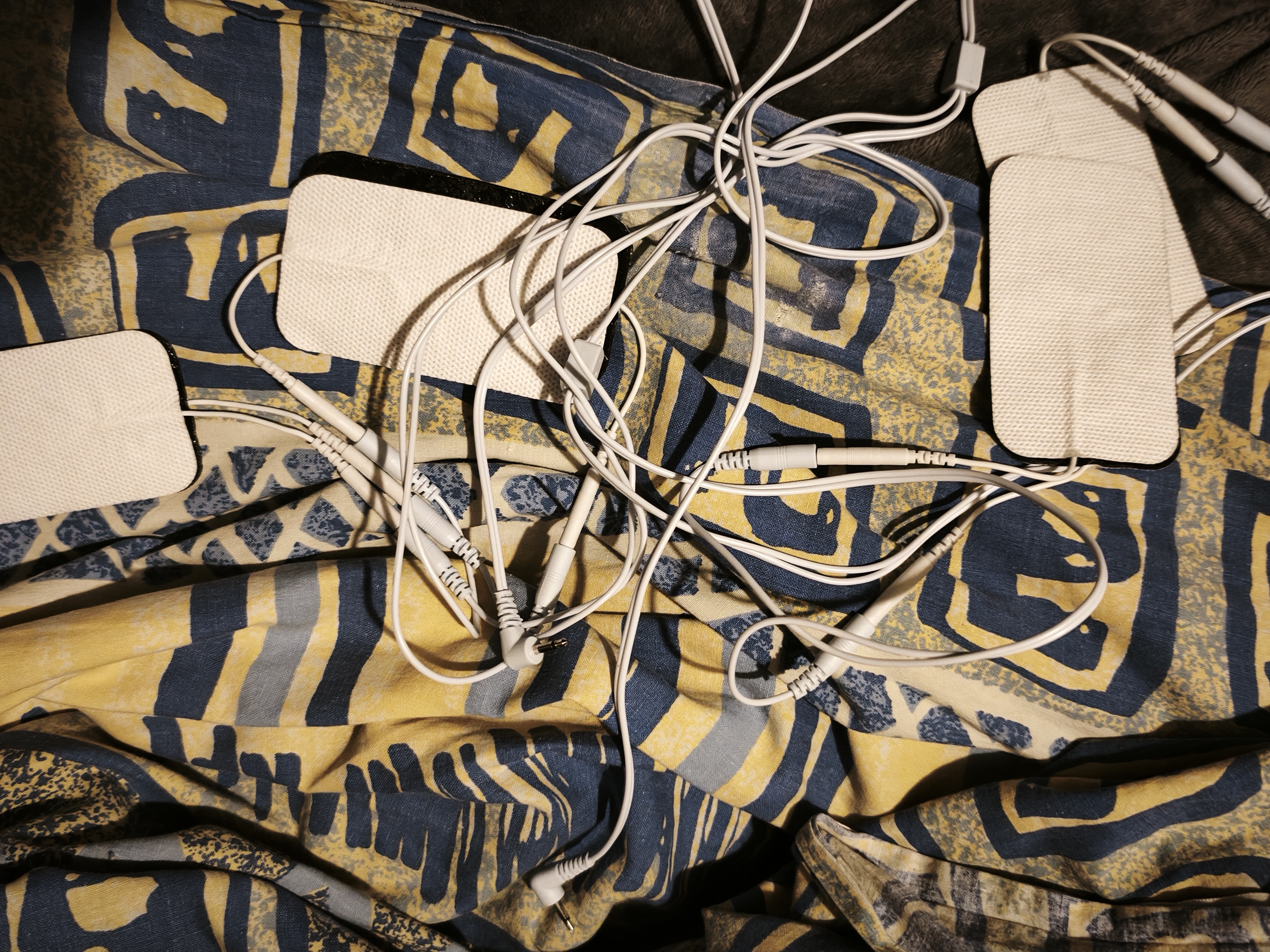
TENS cables
The essential link: TENS cables for the DG-Lab Coyote. 🔗
Indicative price incl. VAT
6.00 € (excl. VAT 5.00 € · VAT 20 %)
Test Sample: 2 câbles TENS 4 sorties
Description
No sensation without a connection. The lead wires link your electrodes to the powerbox — simple, reliable, ready to play.
🔌 2.5 mm jack plug → connects straight to the Coyote, no adapter needed
📍 2 mm pins on the pad side → compatible with standard TENS electrode connectors
👥 Best in pairs → one cable per channel (A & B)
🧵 Flexible, hard-wearing wires for complete freedom of movement
Role in a session. These are what determine the path of the current, and therefore exactly where the sensation is born. One cable per channel, each channel feeding a pair of pads: it is that split which lets the Dom work one leg then the other, or alternate thighs and buttocks without ever sending current across the chest. Their flexibility matters as much as their conductivity: under a latex catsuit they are taped along the body then routed up to the box, and a stiff wire would mark the skin or pull loose at the first movement.
In the sequence, they go on when the pads are placed, are tested channel by channel at low intensity, then unplugged from the Coyote while the catsuit goes on — without ever switching the device off — before being reconnected once the latex is up.
Precautions. Current must never cross the chest or the heart: one cable links two pads on the same side of the body, below the waist. Check the insulation before each session — a bare wire delivers a sharp, painful jolt — and never plug or unplug a cable while the output is live. Intensity always back to zero before any handling.
Care. Wipe the pins with a dry cloth, store the wires in wide loops rather than sharp folds, and replace any cable whose contact becomes intermittent.
My take
Pièce sans éclat mais sans laquelle rien ne fonctionne : les câbles relient les pads au boîtier. La connexion tient bien et ne se débranche pas au mouvement, ce qui est l'essentiel.
Le point de vigilance est le routage. Un câble qui passe d'un côté à l'autre du corps crée un trajet de courant qui ne doit jamais traverser la poitrine. Je garde tout sous la taille, sur un seul côté à la fois, et je vérifie le cheminement avant de mettre sous tension.
Indispensable au montage : le placement compte plus que le câble lui-même.