
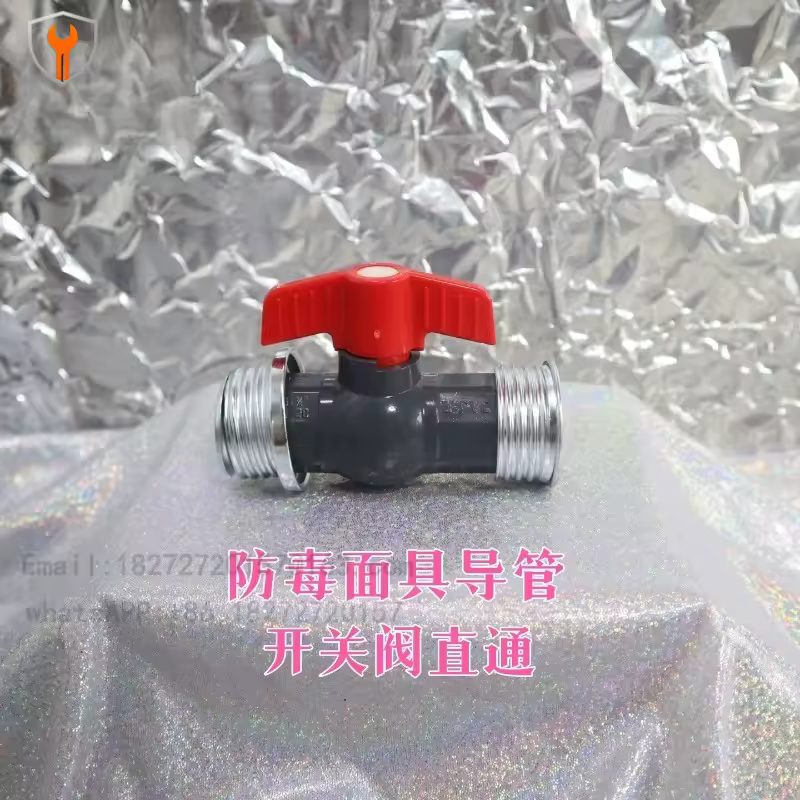
Shut-off valve (ball valve) on a gas mask — why you must never use it to cut off air
Gas-mask shut-off valve: a mechanical device for controlling airflow, suited to immersive role-play and sensory-confinement scenarios.
Test Sample: Valve
Description
This accessory draws on military and industrial equipment, adapted for a BDSM context. Made of hard-wearing metal (brass or steel), it works on the ball-valve principle: a quarter turn opens or closes the airway. Its compact design and solid grip make it a visually strong element in a mask scenario.
What it must never be used for. The name of this entry is a warning, not an invitation. A shut-off valve mechanically allows the air to be cut off, and that is precisely the use to rule out. Airway occlusion — closing the air supply — is not an advanced practice: it is not a practice at all. Loss of consciousness through lack of oxygen happens with no reliable warning sign, within seconds, and can cause neurological damage or death. No safety code, no supervision and no amount of experience compensates for a closed circuit: once the masked person passes out, they can no longer signal anything, and the useful window is measured in tens of seconds.
What it is actually for. The valve is justified as a means of partially adjusting flow, never of cutting it: you modulate a resistance, you make breathing laboured and conscious, you do not remove it. It also serves as a connecting part within a circuit — between the hose and the mask, or towards the scent injector — and as a simple aesthetic attribute reinforcing the “uniform” atmosphere.
Non-negotiable rules. The circuit must be physically incapable of ending up completely closed: always keep a free emergency air intake, independent of the valve. The mask must be removable within seconds, straps loosenable, with no locking around the skull. Constant supervision, never alone, a code of non-verbal signals agreed in advance, immediate stop at the first dizziness, tingling or confusion.
Care. Rinse in lukewarm water, dry thoroughly, check the seal and the smoothness of the quarter turn; a mechanism that catches should be replaced, not forced.
My take
Cette fiche est un avertissement, pas une recommandation. J'ai ce type de vanne, et c'est précisément pour cela que j'en parle : il ne faut jamais s'en servir pour couper l'air.
Un robinet à bille ferme totalement et instantanément. Sur un masque, cela signifie zéro air, sans le moindre signal progressif — la perte de connaissance arrive en quelques secondes, et l'inconscience ne permet plus de rouvrir. Le fait que le geste soit facile et réversible pour celui qui l'actionne est exactement ce qui le rend dangereux.
Son seul usage acceptable est le réglage d'un circuit hors restriction respiratoire. Pour jouer avec le souffle, il faut un dispositif qui limite sans jamais fermer.